anti anti anti anti anti corruption
During an interview process for an Africa investment fund, I was asked on my thoughts on corruption in Africa and how to avoid it. I am always trying to be careful with what I say on this topic. Not because I advocate for corruption, rather because I think its misunderstood. And saying that corruption is misunderstood can be misunderstood, and being misunderstood can be misunderstanding. I obviously said something diplomatic like corruption is bad. The topic kept coming up a few times with friends (Arno and Kareem I see you). I thought to throw everything I know here to provide a swarming view on corruption in this edition and unpack it like never before.
Corruption on the spectrum
In simple terms, corruption refers to dishonest or illegal behavior. In even simpler terms, its the process of doing bad things. A corrupt person is an agent of that process. What constitutes as bad is a matter of one’s moral stance, but also largely a matter of perception.
Saying that people can be pure and not corrupt is a naive take. Philosophy aside, the popular way to measure corruption is the The Corruption Perception Index (CPI). I love the term perception index because it puts everyone on the spectrum, as if corruption is intrinsic. The index scores countries out of 100, and they move up and down each year. The closer you are to 100 (light yellow), the less corrupt you are. The closer you are to zero (red), the more likely you are to be a corrupt country.
Verdict: almost everyone is corrupt! Yeah, buckle up. We are about to get cynically red bebe..
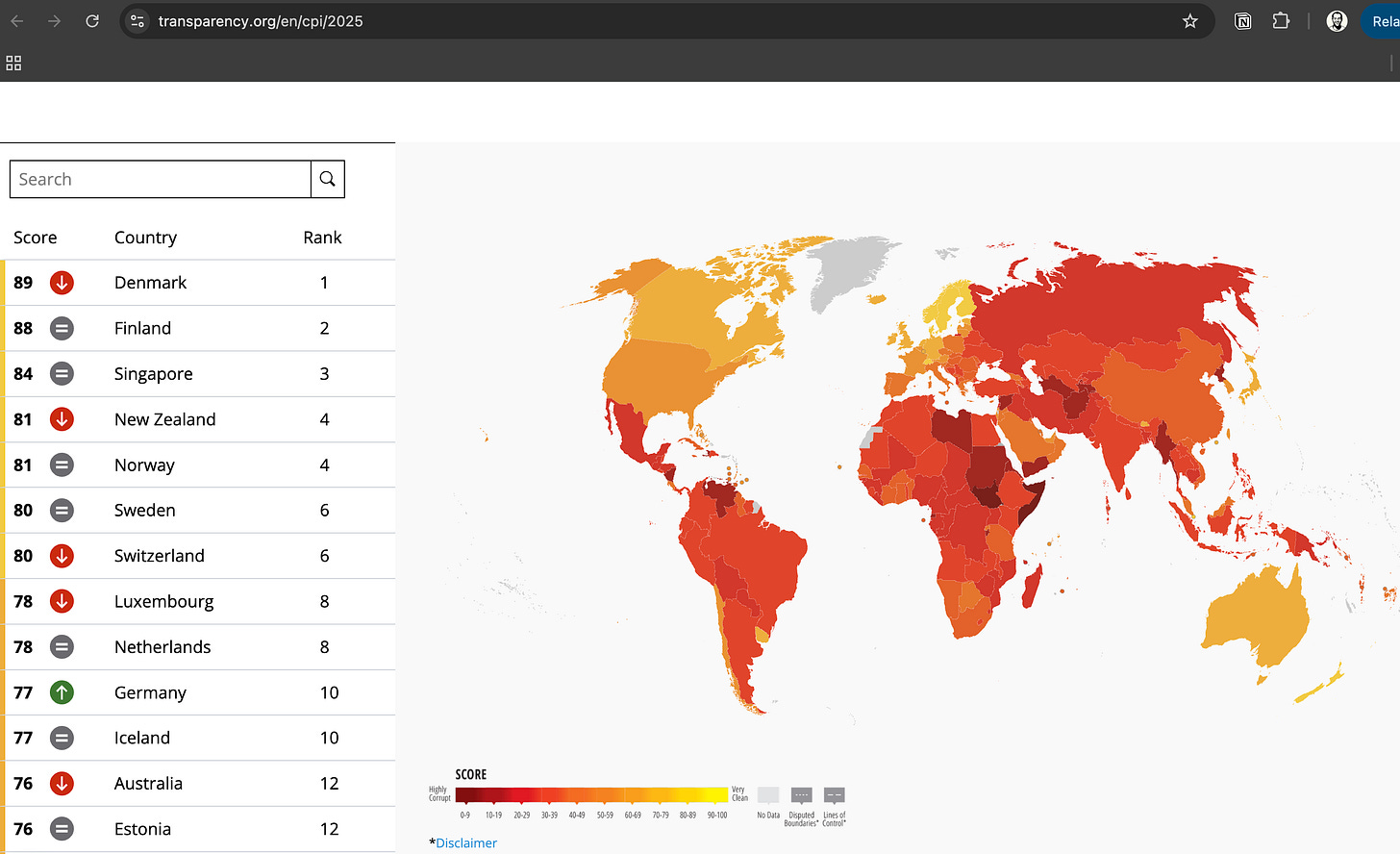
Measuring corruption is a subjective matter, hence why at the mercy of “perception.” One might then ask: whose perception, though? Well, the CPI is published by Transparency International, which is based in Berlin, Germany. They basically aggregate a composite of surveys to assess bribery of public officials, diversion of public funds, officials using their public office for private gain without facing consequences, the government’s ability to enforce integrity mechanisms, red tape and excessive bureaucratic burdens that increase the likelihood of corruption, and nepotism in civil service appointments.
I have a huuuge question mark over how these surveys are conducted. What if Transparency International has to bribe certain officials to conduct them surveys lol? The kind of plot twist I started this newsletter for.
Little thieves, big thieves
The first thing that pops up to ones head when thinking about corruption is bribery. Bribery has two layers. I classify them into front end and back end bribery. As Fela Kuti sings in I.T.T. International Thief Thief “I have seen the future, there are little thieves and there are big thieves”
Front end bribery is direct day-to-day cash with people-interacting public officers such as: the police, custom officers, immigration officers, etc… the amount paid here is usually a reasonable amount ranging from $1 to $100.
Front end bribery comes in two intertwined forms: Facilitating a certain public service and/or avoiding being reported and harassed.
Its common that public officers are slow and inefficient. They themselves know it. Which is why they also use it for their benefit. To fast track a certain process paying extra fees helps facilitate a service. This occurs so often that many authorities made this official. Think visa services. Today you can pay more to have your visa fast-tracked as opposed to things being slow and have you wait. Facilitation fees here mimics a bribe.
It is also common that public officers are not well paid. The idea that front end public officers are usually considered morally bad people because they take bribes, is an idea I morally choose to refuse. They are simply poorly paid. Hence, bribery is a system akin to that of a tipping system yet pre-service instead of post-service, where public officers benefit from to cover other means of life expenses.
A global swarming analysis (2026)
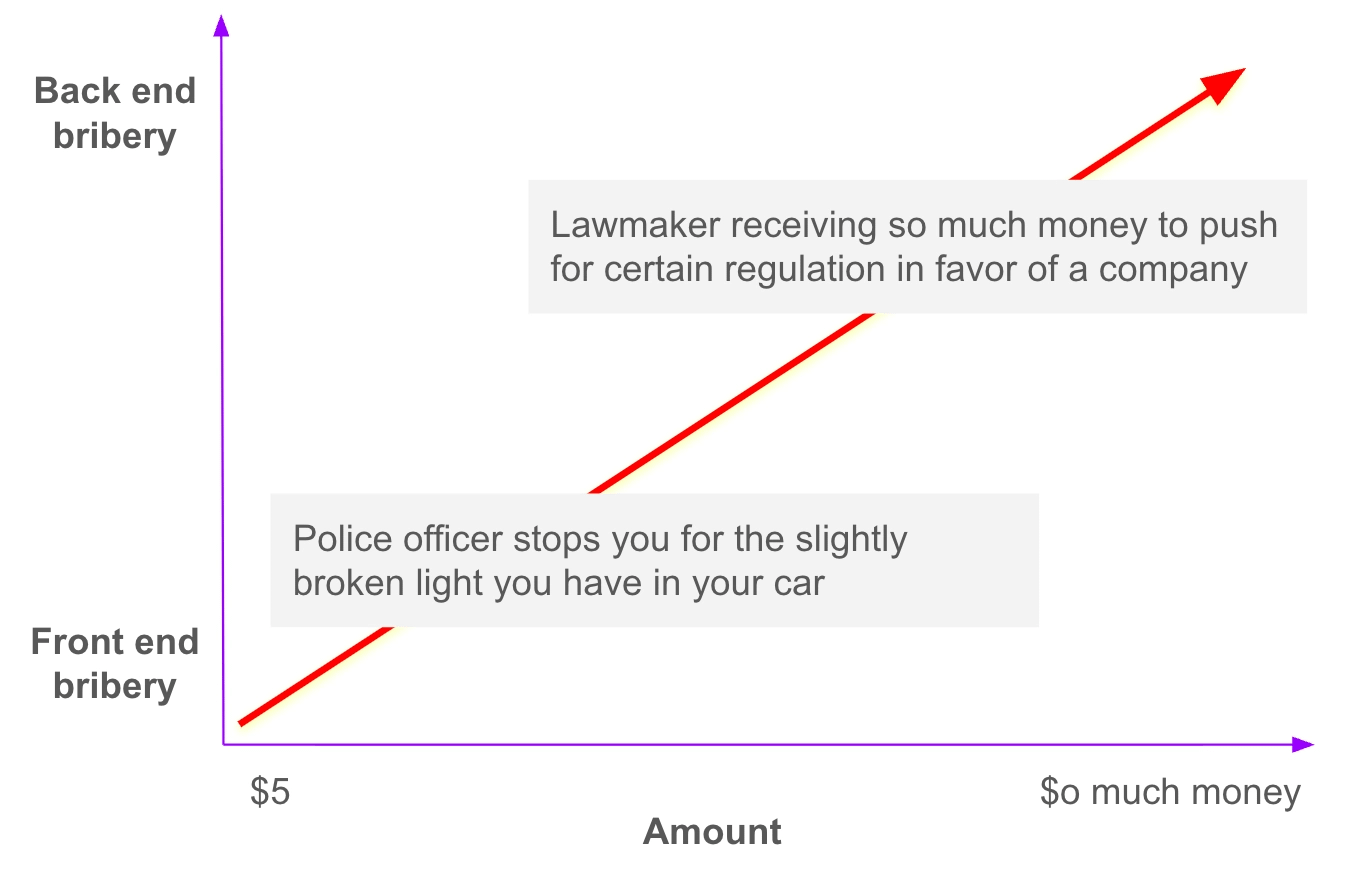
And if one tries to avoid bribing front-end officers, the chance of getting reported, and instead having to bribe someone higher in rank who is less in need of money, grows. So it’s cheaper, and by contrast more impactful, to pay something to the first officer.
This brings me to back-end bribery. Simple examples are those where lawmakers receive large sums of money to grant business licenses to people they favor, or to push for regulation that favors a certain company. Politicians can also partake in embezzlement. Thats like stealing from tax payers money via funds or inflating public spending towards ghost projects.
It should not be surprising the length people in power would take to steal money. Some mechanisms are secretive and complex, some are audacious and in your face. One of my favorite cases is when Robert Mugabe the previous president of Zimbabwe won a draw out of thousands of participants carried out by a local bank for its clients. The prize was £1,600.
Economic Revolution from Above
Michael Klein was my favorite professor during my master’s program. He played a big role in shaping my worldview on international development. He always had these crazy stories from advising governments on development policy from his time as Chief Economist at the World Bank. In 2011 he wrote a policy research paper for the World Bank titled “Enrichment with Growth” in it, he lays out the business model of the corrupt. He argues that traditional, destructive forms of corruption (like warlords looting a country) are actually a terrible “business model” for getting rich, but that corruption can be indirectly constructive: when the elite want to maximize their wealth, they are heavily incentivized to modernize and grow their country’s economy first. In other words, the paper argues that the very experience of rapid, historically unprecedented growth can motivate elites to seek new ways of enrichment that can actually lead to a better life for all. He calls it “economic revolution from above.”
Those who wish to enrich themselves need to solve several problems. They need to find partners. Partners to obtain favors from, and partners to collaborate with to obtain such favors. They then need to monitor whether the partners stick to their commitments and enforce them. They need to do this largely without the help of formal institutions such as contracts or courts.
Somehow the corrupt partners must find each other. Paradoxically, the tinder for the corrupt is the press.
Nigeria’s corruption tend to be quite prominent even amongst those that never been to Nigeria. When I lived there, I saw how people in power actually enjoyed that label because it sends a signal to people that want to do business in Nigeria to know what to expect. In fact, to some degree, public accusations of corruption may in fact facilitate match-making for corrupt business relations.
Take for example this news story from last month: ‘I have fired 40 of my agents for being corrupt’, says Nigeria’s anti-corruption chief. Bruh! it cant get more twisted than that lol
Or this Washington Post story from 1983:
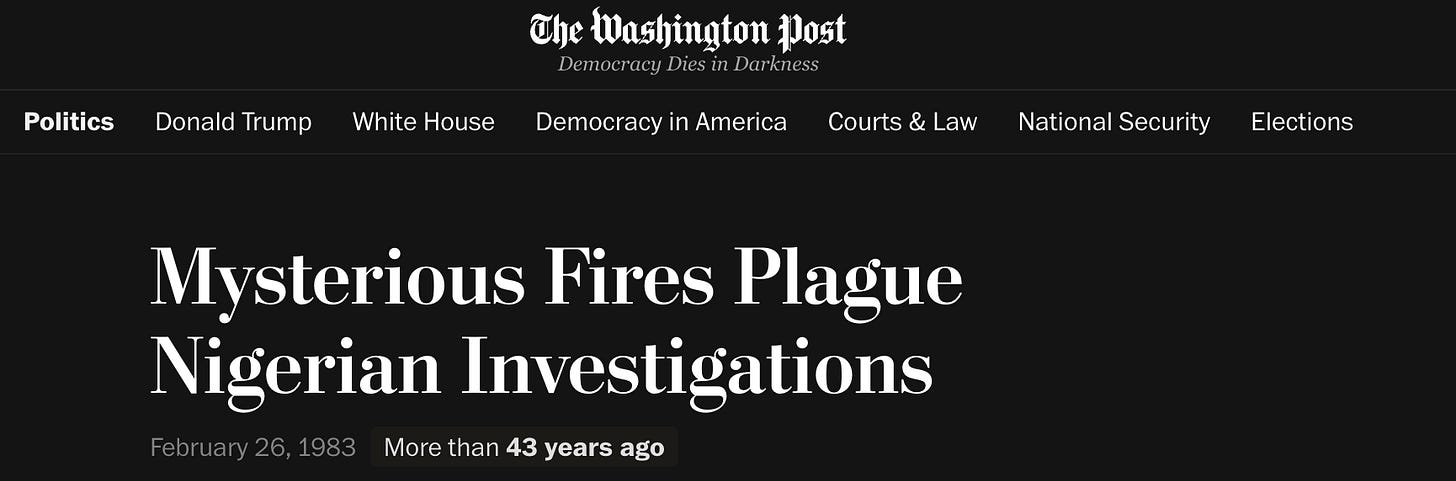
The article goes on to describe the tradition of fires breaking out in Nigeria, not in kitchens, but in accounting departments.
A typical setting for meeting and assessing potential partners would be somewhere informal usually hotel lobbies or private residency. The setting is relaxed; no obvious agenda is visible others than a friendly visit and a subtly explore.
Before a deal can be done between the principals in a corrupt transaction, they might use intermediaries to prepare the terrain. They know corrupt people. They may have long-lasting relationships with multiple parties on both sides and are thus able to build trust.
They get their income from fees that can look legitimate — the “consulting fee” —without actually participating directly in grand corruption. In fact, intermediaries may command extra trust, if they stick to their normal “fee schedule” and clearly stay away from asking for a special cut in deals.
The assessment of whether to trust someone to be willing to commit an illegal act tends to be a drawn-out process, as potential partners observe a host of subtle clues about each other, before broaching the true deal directly. You know like first day at uni where the stoners find themselves.
One way of building trust is waiting games. Waiting games can serve two functions. They select people who are interested to wait and thus seem sufficiently desperate for a deal. Silence also serves to place pressure on the waiting party to show his hand, possibly by offering a “good deal”, thereby revealing willingness to enter into corrupt relations.
it is rational to maintain de facto “fee schedules” of who needs to be paid and with how much. It is also necessary to keep new entrants out. Hence, corruption requires good project management. The more the players the likely the gains erode. According to Michael Klein, normal transaction costs tend to amount to some 3 per cent of project cost, whereas in complicated environments these costs can go up to 10 per cent or more.
When it comes to personality treats, the corrupt must exert patience, trust, and loyalty. These traits when combined with discretion tends to lead to nepotism further underpinning the circles of the corrupt.
Core-ruption
Eventually, things get built and done for the country. Fast transactions, slow implementation. Remember waiting games?
The poster child for this syndrome is the multi-billion-dollar Ajaokuta steel plant in Nigeria. The plant was conceived in 1964, started in 1979 with outdated Soviet technology, completed in 2004, shut down again and reopened in 2010. Eat, Steal, Steel, Repeat.
In Malaysia, an estimated US$4.5 billion was embezzled from the sovereign wealth fund 1Malaysia Development Berhad (1MDB), founded in 2009. $700 million alone went to the Prime Minister. The scheme was to approve investments in projects and companies that had offshore bank accounts. Some of these companies belonged to the very architects of the fund. In fact, the most ironic part of the 1MDB scandal was that the Wolf of Wall Street movie was funded with the misappropriated money. Meanwhile, Margot Robbie continues to misappropriate our souls 🥲

If you thought 1MDB was wild, welcome to “Operation Car Wash” Brazil’s state oil giant, Petrobras, needed massive construction work. A cartel of major construction firms colluded to rig the bids and secretly inflate contract prices. The extra money was laundered through currency exchange shops (at the car wash!) and funneled straight into secret offshore accounts for executives and politicians. In total, the scheme siphoned off over $10 billion.
It got so systematic that construction titan Odebrecht created a literal ”Department of Structured Operations” a fully staffed, encrypted corporate division dedicated entirely to managing global bribes.
These are some of the heaviest cases in history. They involve a large number of corrupt partners, and many of the players have Western ties: rating agencies, consulting firms, auditing firms, multinationals and, most importantly, global banks and offshore accounts.
Corruption where corruption is forbidden
The reason Western countries score so well on the Corruption Perceptions Index is that it misses legal influence-buying and the role these countries play in facilitating corruption abroad. So a country can score very well on everyday integrity while being a major player in grand corruption elsewhere. A lot of illicit money eventually ends up in Western financial centers and their linked jurisdictions.
The Pandora Papers and the Panama Papers are good sources on that entanglement.
Front-end bribery is rare in the West, and most people never encounter it. What exists instead is quieter, often more sophisticated, and sometimes perfectly legal.
I am obviously resentful towards the double standards. Almost everyone instinctively calls out Africans as corrupt. In the investment world, African founders receive extra scrutiny out of fear of fraud. But US investment fraud keeps on giving, starring Bernie Madoff, who orchestrated a $65 billion investment fraud in the US, and Allen Stanford, who sold $7 billion worth of fake certificates of deposit through a bank in Antigua. Even effective altruism militants such as Sam Bankman-Fried managed to steal people’s money.
Then there is, oil giant Enron, global telco WorldCom, Germany’s wanna-be big tech Wirecard, Europe’s eron Parmalat, blood sucking Theranos, the people’s car Volkswagen Emissions Scandal, and Germany’s masqurade Mask Scandal, to name a few.
Corruption is the solution, not the problem
In 2019 I read “The Prosperity Paradox” a book on finding new ways to solve poverty in poor countries, co-authored by Nigerian Efosa Ojomo and Prof. Clayton Christensen, the man behind the theory of “disruptive innovation.” It has a chapter titled “Corruption Is the Solution, Not the Problem.” In it, they argue that people hire corruption in order to make progress, and when a society offers few legitimate options for making progress, corruption becomes more attractive. If the official route is slow, expensive or unpredictable, a bribe is often the quickest way through. In that sense, it is a “solution.”
The popular view is that poor countries must fix corruption before they can develop, is a weak thread. The authors emphasize, societies don’t develop because they’ve reduced corruption; they reduce corruption because they’ve developed.
Such a lens is very important because it allows us to view the world with a little bit of humility!
Values, the de facto institutions
In hindsight, corruption does not mean that people are bad in the countries the CPI ranks lowest. Societies with weak institutions and rule of law tend to place more value on things like reputation, where stealing is a really big deal. What outsiders call corruption often is not seen as bad locally.
Consider gift culture and generosity, another highly regarded values in places like the Middle East and Africa. Cash is the standard form of gift; birthday gifts are always cash. Sometimes you give extra cash to the police officer in your community even though you weren’t stopped or harassed, simply as a gesture of respect, care and generosity.
In a way, the citizen is incentivized to be generous towards the person enforcing the rules, knowing he is poorly paid. In turn, out of a sense of shame, the officer develops a feeling of responsibility toward society, creating a virtuous circle.
its a paradox: the same social glue that makes corruption work, such as trust, loyalty, reputation and generosity, is also what holds these societies together.
Values without institutions, and you get underpaid officers who will harass you for a little cash to make things move. Institutions without values, and you get world-class theft of people’s money and souls while pointing fingers at others.